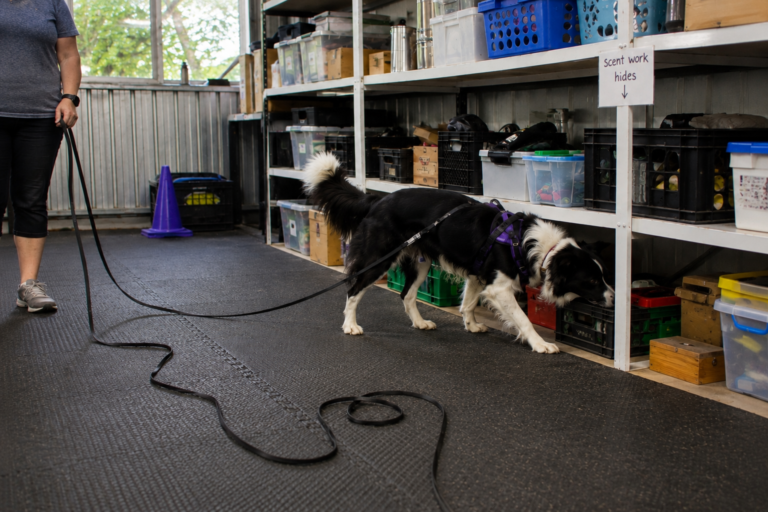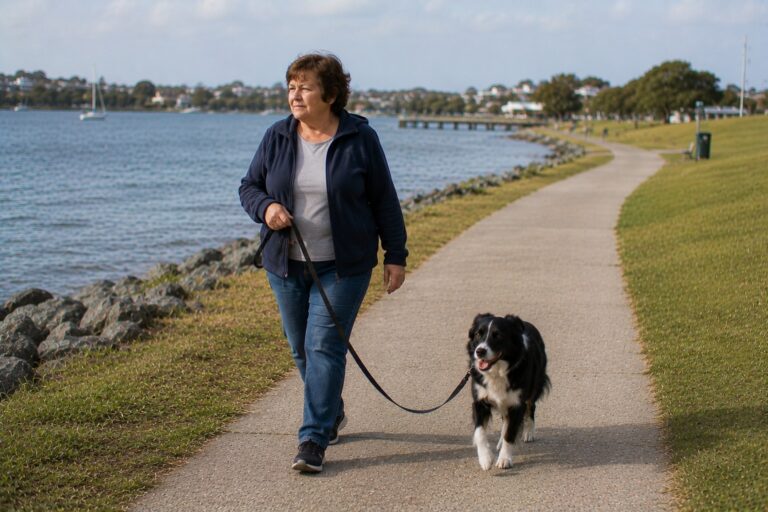
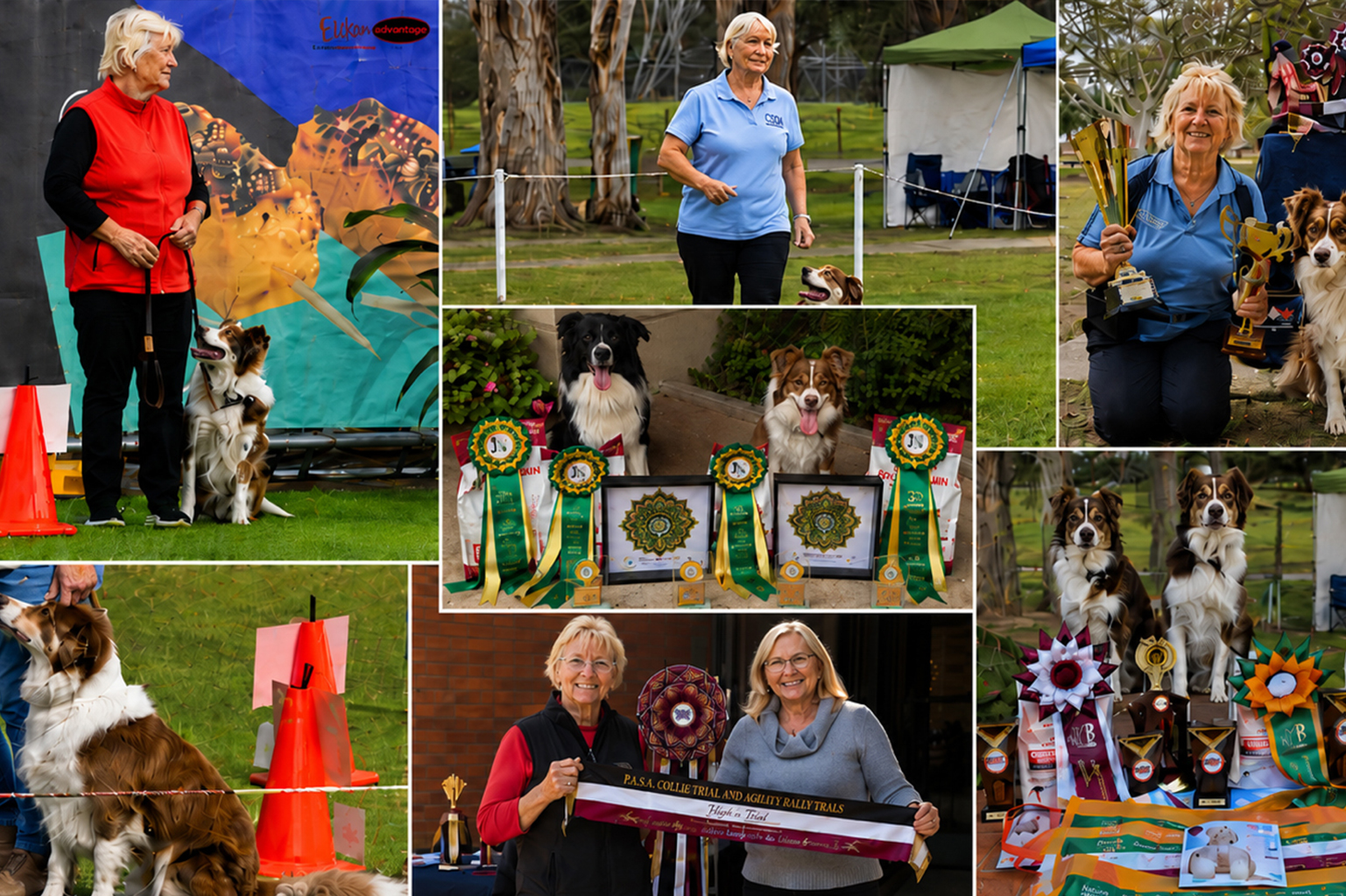
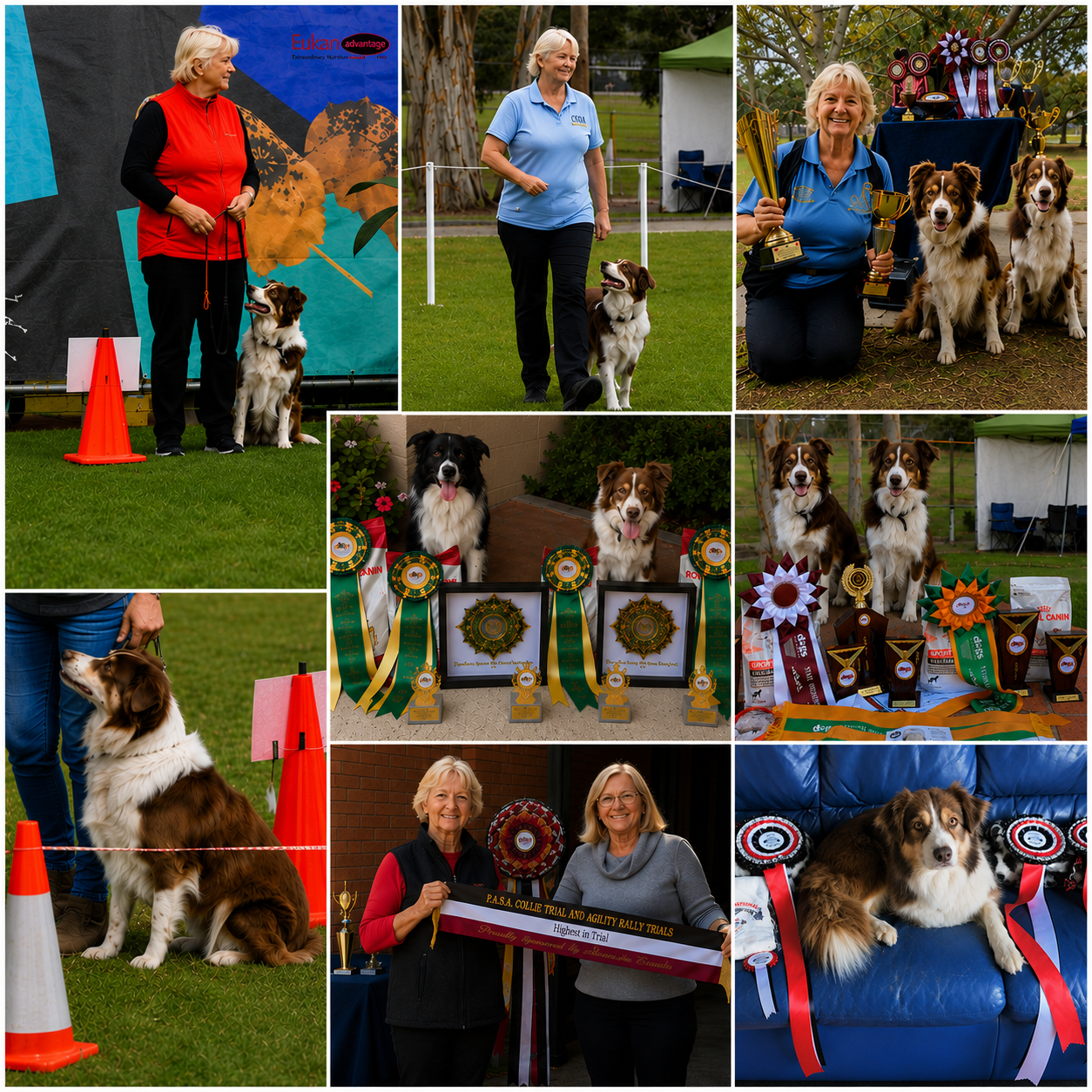
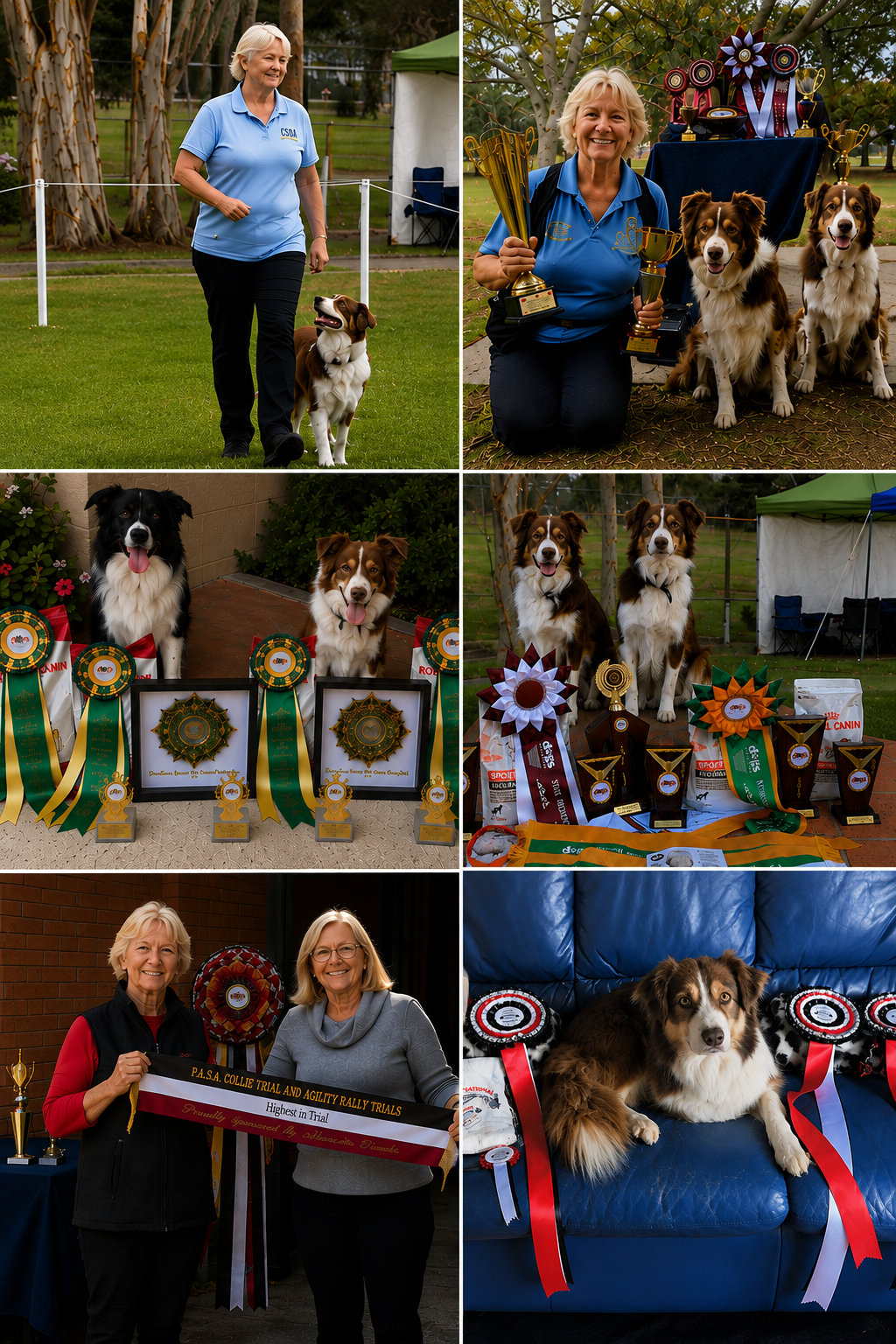
Caroline and her dogs competing in Rally over the years, with some of the prizes they’ve collected along the way.
Getting started in Rally
Looking for a fun sport that puts both you and your dog to the test? Rally could be just the ticket.
Part Obedience, part obstacle course, Rally requires you and your dog to complete a series of exercises as you work your way around a course of numbered stations.
Sit. Drop. Turn. Change pace. Come to front. Finish. Walk around your dog. Recall. And just when you think you’ve got everything sorted, along comes an exercise that makes you stop and think: Hang on — which way am I supposed to turn?
That’s half the fun.
Rally uses many of the skills found in formal Obedience, but the atmosphere is more relaxed. Best of all, you can talk to your dog. You can praise them, encourage them and tell them just how clever they are as you tackle the course together.
And while Rally is relatively easy to get started in, don’t mistake relaxed for easy. As you climb through the levels, the courses become longer, the exercises more complex and the human half of the partnership has to do an increasing amount of thinking.
So how does it work?
A Rally course is made up of a series of numbered stations. Each station has a sign detailing the exercise dog and handler must perform before moving on to the next one.
Before competing, handlers walk the course without their dogs. This is your chance to see how it flows, check the sequence and make sure you understand the exercise required at each station.
One station might require your dog to sit while you walk all the way around them. Another might involve a particular turn, a change of pace or a recall.
At Novice, your dog works on lead and the exercises are relatively straightforward. As you progress through Advanced, Excellent and Masters, the lead comes off and the challenges increase.
That’s when Rally really starts to get interesting.
It’s a workout for the human brain too
At the higher levels, you aren’t just testing your dog’s training. You’re testing your own ability to read the course, remember where you’re going and perform each exercise correctly.
Some signs look deceptively similar. Courses can double back on themselves, and there are changes of pace and direction, recalls, pivots, position changes and exercises at a distance.
It’s excellent for keeping the old grey matter ticking over.
Sometimes dog and handler sail through in perfect harmony and everything falls into place. Other times the dog is brilliant and the handler arrives at a station, looks at the sign and has a spectacular blonde moment.
Experienced Rally dogs can become remarkably good at the game too. Caroline sometimes jokes that Hope has read the signs before she has, because Hope seems to know what is coming next.
Serious competition — without taking yourself too seriously
One of Rally’s great attractions is its social side. Yes, people want to do well. There are titles to earn, personal bests to chase and championships to win. But there is also plenty of cheering each other on, laughing about what went wrong and comparing disasters afterwards.
Sometimes the unofficial competition seems to be who can accumulate the most incorrectly performed stations in a single round.
That camaraderie is one reason Rally can feel less stressful than formal Obedience.
In Obedience, communication between dog and handler is much more restricted while an exercise is being performed. Rally is different. You can talk to your dog throughout the course, praise them and encourage them.
Caroline has even been known to tell a dog “Love you” as she goes around — occasionally to the amusement of the judge.
For dogs that thrive on interaction with their owners, that freedom is a big plus. For handlers, it means you can relax a little, enjoy the round and let your dog know when they’re doing a great job.
CLEAR THINKING
Rally is challenging enough to keep you thinking, relaxed enough to let you laugh at your mistakes, and a great way to have fun with your dog.
You can recover from a mistake
One mistake doesn’t necessarily mean it’s all over. If you realise you have made a mistake at a station, you can retry the exercise at a cost of three points. But if you don’t realise you have made the mistake and simply carry on, you will receive an IP — Incorrectly Performed — and lose all 10 points for that station.
So recognising your own mistakes can be rather important. Sacrificing three points and getting it right the second time is a much better deal than losing 10.
Too many mistakes will certainly put you out of contention for the ribbons, but one imperfect station doesn’t necessarily end your chances of qualifying.
And Rally does produce some memorable mistakes. There is nothing quite like finishing a course feeling enormously pleased with yourself, only to discover that while your dog performed beautifully, you did the wrong exercise.
The dog, of course, usually knew exactly what it was doing.
From Novice to Grand Champion
You don’t need a highly trained dog to begin Rally. If your dog can walk reasonably beside you and has the beginnings of sit, drop, stand and recall, you already have plenty to work with.
Competition progresses through Novice, Advanced, Excellent and Masters. You need three qualifying passes for Novice, three for Advanced, five for Excellent and seven for Masters.
For those who really get the bug, there are championship titles beyond that. Rally Champion requires 10 qualifying scores of 90 or more at Masters level. From January 2026 there is another goal to chase: Rally Grand Champion, requiring a further 10 Masters scores of 95 or better after gaining the Rally Champion title.
That’s serious Rally.
Caroline Strainig has competed successfully in Rally for many years, with numerous National, State and Royal Show wins with her dogs, including her current, much-loved Border Collies, Adam, Hope and Lockie.
But you certainly don’t need ambitions of becoming a champion to get hooked on Rally.
Have a go
That’s perhaps the nicest thing about the sport. You can take it seriously enough to chase perfect scores and championship titles, or simply enjoy learning the exercises and seeing how far you and your dog can go.
Start by learning some of the basic signs and practising the exercises individually. Then string three or four together into a little course in the backyard or park.
Better still, find a club offering Rally classes or go along to a competition and watch. You’ll soon get the idea.
And don’t be intimidated by competitors who appear to know exactly what they’re doing. Sooner or later, every Rally handler stands in front of a sign with their brain temporarily empty while their dog looks up as if to say: Well? I’m ready. What are you doing?
And that’s Rally.
Rally is offered by many Dogs Queensland affiliated clubs. Visit the Dogs Queensland website to find a club near you. Caroline also offers private sessions for dog sports competitors who want help developing their skills and preparing for competition.