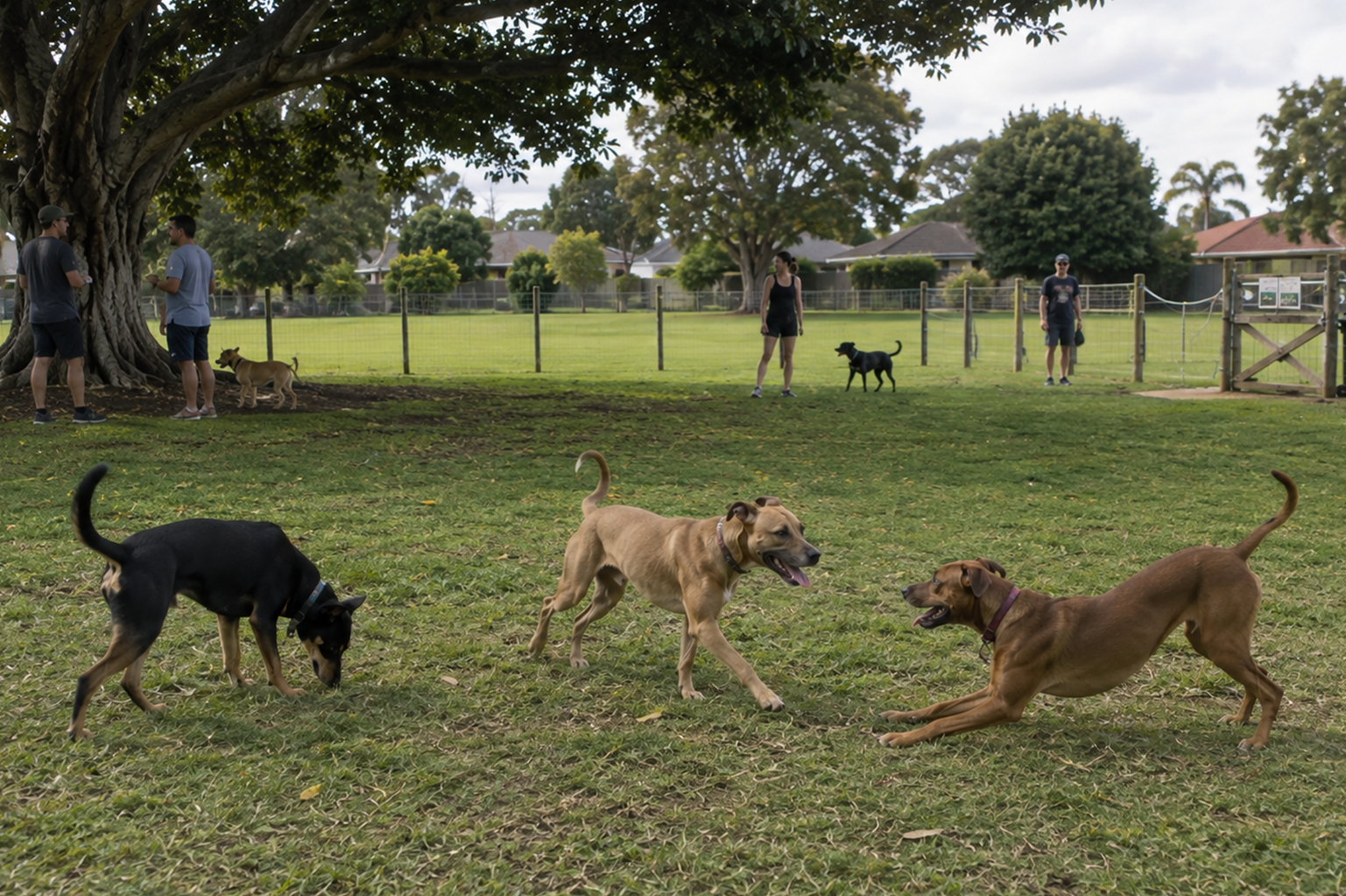
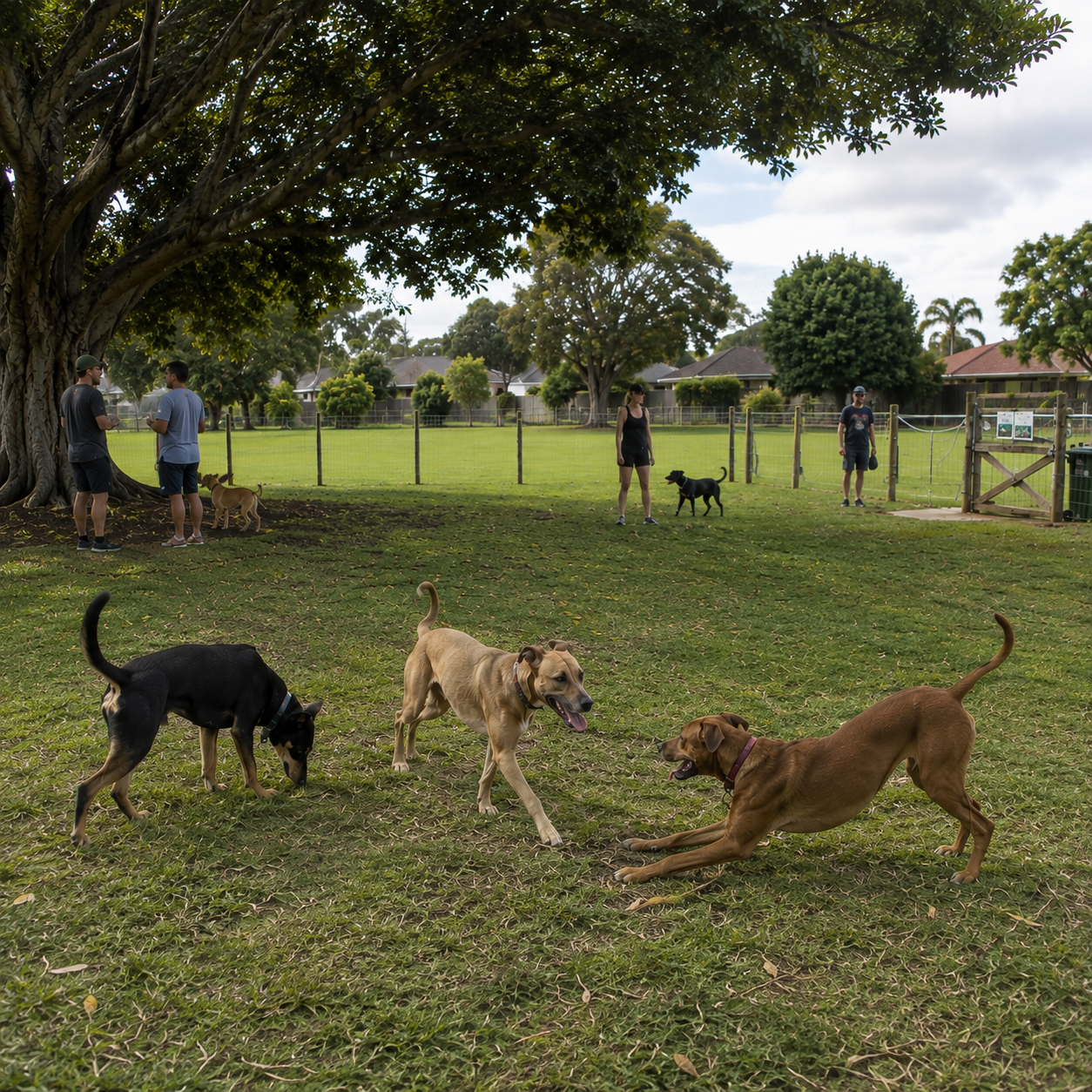
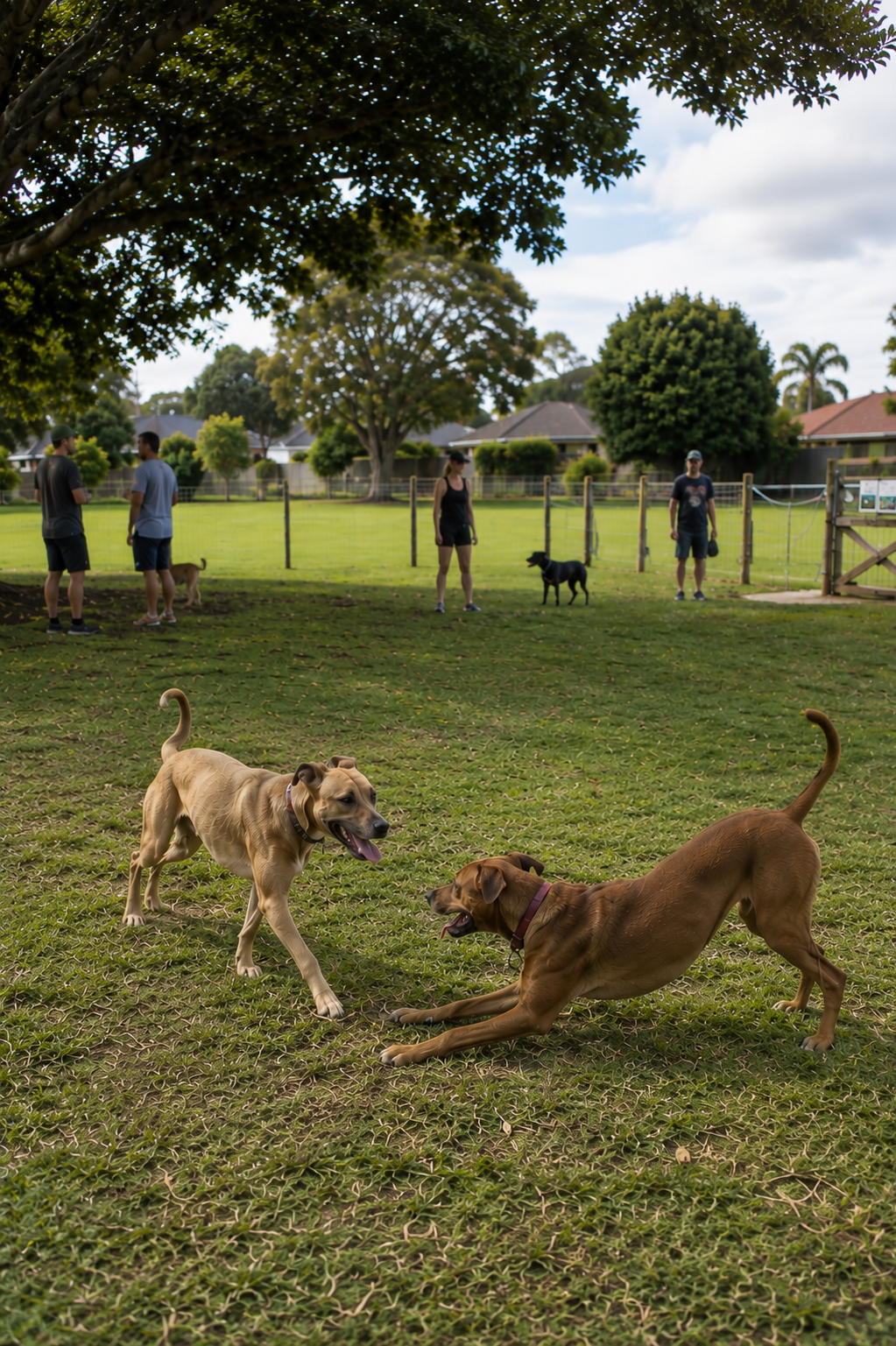
Play should be a two-way conversation. Watch for loose bodies, natural pauses and both dogs choosing to come back for more.
When dog-park play gets too rough
Dog play can involve chasing, growling, wrestling and body contact that would look alarming in almost any other context.
The question came up at Elanora Park, Wynnum, recently when a past CLEAR client stopped to ask Caroline about her dog. Usually it plays well with other dogs, but occasionally things get a little too intense. There was also one particular dog it had some history with after previous play had become rough.
Should she interrupt and move her dog away? Or, if it was only a mild lapse in manners, could the dogs have another go?
The answer depends on what happens next. An interruption doesn’t necessarily mean the game is over. Sometimes all that is needed is a short break, followed by a decision about whether it is sensible to let the dogs re-engage.
Rough doesn’t always mean wrong
Dogs can chase, wrestle, growl, shoulder each other and roll around while having a fabulous time.
Rather than judging play simply by how rough it looks, watch whether it is mutual.
The question isn’t simply, “Is this rough?” It’s, “Are both dogs still choosing the game?”
Good play usually has give and take. One dog chases and then gets chased. Wrestling positions change. There are natural little pauses before somebody starts the game again. Bodies are generally loose rather than stiff and, most importantly, both dogs keep choosing to participate.
When that balance disappears, take a closer look.
Be particularly careful with chasing. Some dogs love a good chase game and, when both dogs are taking turns and choosing to continue, there may be no problem at all.
But don’t assume that a dog running away is necessarily playing. Watch the dog being chased. If it is trying to escape, looking for its owner, tucking its tail, becoming increasingly frantic or showing other signs of discomfort, intervene and call off the chasing dog.
A frightened or overwhelmed dog may eventually turn and snap because its earlier attempts to get away haven’t worked. What one owner thought was a harmless game can then turn into a confrontation very quickly.
The same applies to repeated pinning, body-slamming or a dog becoming fixated on another that is trying to disengage.
Don’t wait for a fight to decide there was a problem.
When to interrupt play
The ideal time to interrupt is when play is beginning to change, not after it has already tipped over into trouble.
Running may become faster and more frantic. Wrestling gets harder. Natural pauses disappear. A dog that was happily mixing with several dogs may suddenly become completely focused on one.
Learn what that change looks like in your own dog.
When you see it, interrupt. Call the dog away if it has a reliable recall or calmly go and collect it. Move away from the action and give it time to settle.
This isn’t punishment and it doesn’t automatically mean playtime is over.
Once things have calmed down, reassess.
Briefly hold back the dog that was being too pushy and watch what the other dog chooses to do. If it comes bouncing back and actively invites more play, the dogs may be perfectly happy to have another go.
If it wanders away, stays with its owner or shows no interest in returning, respect that decision.
If play resumes but quickly becomes too intense again, end that interaction. One interruption can be a useful circuit breaker. Repeated interruptions usually mean it is time to move on.
CLEAR THINKING
The best time to step in is before play gets out of hand. Interrupt early, let the excitement settle, then decide whether it’s sensible to play again.
Not every dog has to be a friend
If a dog repeatedly has problems with one particular dog, there is little to be gained from putting the pair together again and again and hoping they will sort it out.
There are plenty of dogs in the park. Your dog doesn’t have to play with the one it doesn’t like.
Move away and find more compatible company. Being able to notice another dog, disengage and get on with something else is a far more useful skill than expecting a dog to interact happily with every dog it meets.
Practise the Collar Grab
One of the simplest ways to make dog-park interactions easier to manage is to teach a dog to be comfortable having its collar taken. Collar Grab is an exercise taught in CLEAR Dog Training’s Foundation training.
Start at home with a treat in one hand. While the dog nibbles the treat, calmly take hold of its collar with the other hand, then release. Repeat until the dog is completely comfortable.
Then stop showing the money up front. Take the collar first, then produce the treat.
The aim is to make being caught a familiar, well-rehearsed behaviour rather than something that happens only when the dog is in trouble or the fun is ending.
Practise at the dog park too. Occasionally walk up, take the collar for a second and release the dog to continue playing. Then, when an interaction really does need interrupting, both dog and owner already know what to do.
Be sensible with food in an off-lead park. Avoid a pouch full of chicken or other irresistible treats that may attract every dog in the vicinity. A couple of dry treats tucked into a pocket — those T-shirts with a small pocket high on the chest are particularly handy — are usually enough.
A well-practised Collar Grab means an owner can catch their dog when they need to.
Know your way out
Dog parks with multiple entrances and exits are your friend. Notice where they are before you need them.
Elanora Park is a good example. There are three access points to the main dog park and at least two to the small-dog area, giving owners options if they need to create some space.
Move away up the park and use another gate if necessary. There is no reason to take a dog straight back through a crowd around the main entrance, particularly if the dog involved in the problem is still there.
Sometimes distance is the simplest solution.
What if it isn’t your dog causing the problem?
If another dog is persistently chasing, pinning or overwhelming a dog that is trying to disengage, step in.
A dog shouldn’t have to progress from subtle signals to growling, snapping or fighting before somebody listens.
Collect your dog, create some distance and find somewhere else to play. If necessary, leave.
And if at any point you feel unsafe, or feel your own dog is treating other dogs inappropriately, leave. There is no prize for staying to see whether things improve. Your safety comes first, and preventing a serious confrontation matters too.
One major fight can have a long-lasting effect. A dog that previously felt comfortable around other dogs may become wary or reactive afterwards, and an upsetting incident can also undermine an owner’s confidence. It is far better to end a park visit early than wish afterwards that you had.
Dog parks can be wonderful places for dogs that enjoy them, but owners still need to pay attention. Watch the play, learn the early signs that excitement is building and intervene while the dogs are still capable of settling down.
The aim isn’t to stop dogs playing hard or having fun. It’s to notice when the game is changing and step in before somebody stops enjoying it.