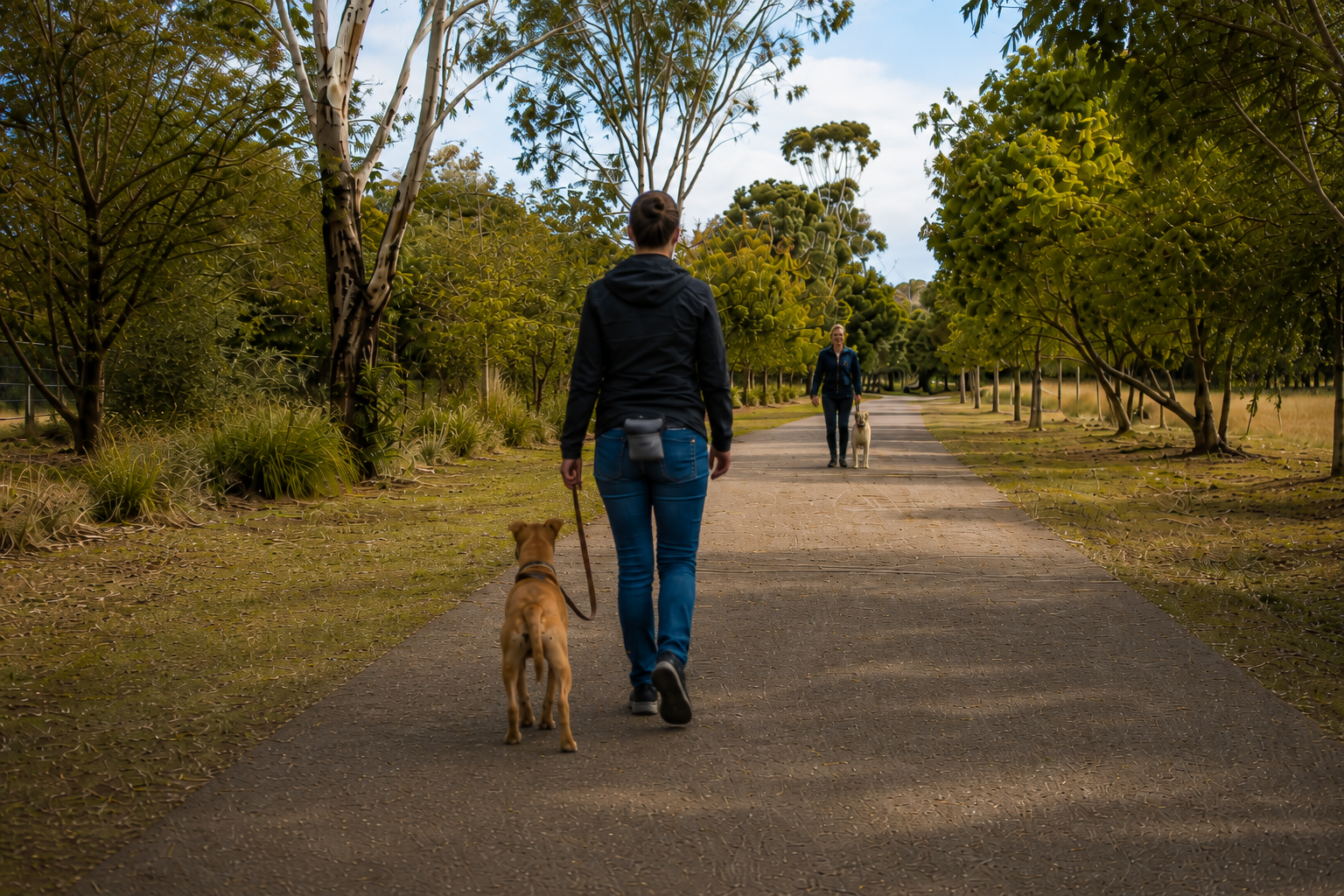
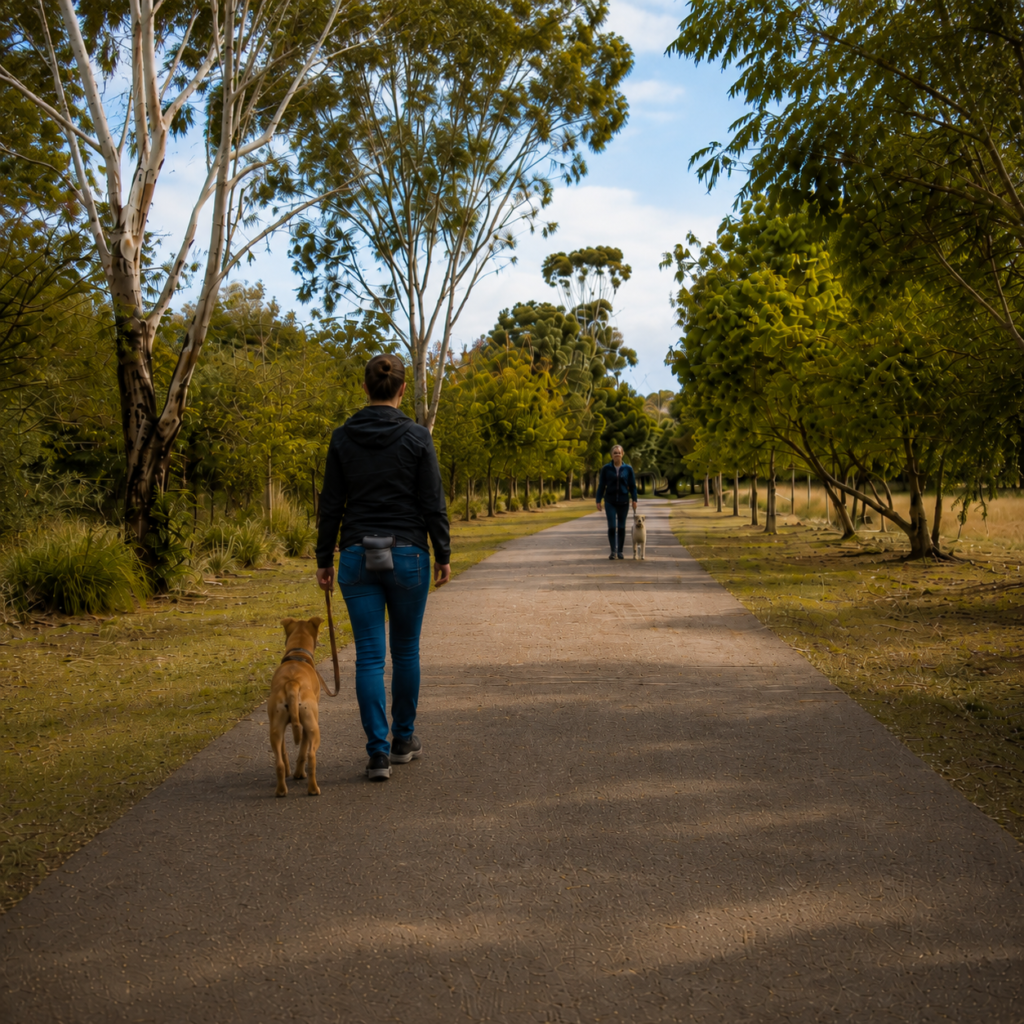
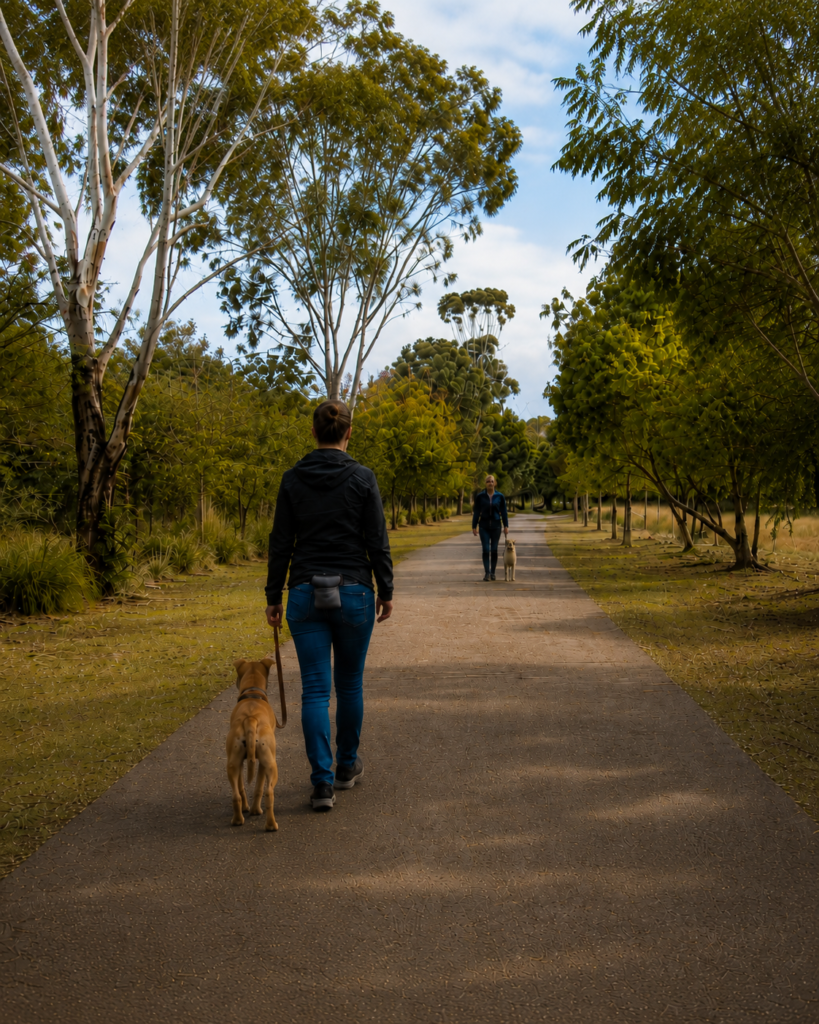
The lunge may be dramatic, but the best time to intervene is usually well before it happens.
Lunging on lead: why dogs do it — and what to do about it
Your dog spots another dog coming towards you. The sniffing stops, his eyes lock on and his body becomes still. Then, as the other dog gets closer — bang. He lunges.
He may bark or growl as well, or he may not make a sound. So what is going on? Is he frightened, frustrated, desperate to say hello — or does he actually want to attack the other dog? The answer is: you can’t tell from the lunge alone.
Reactivity doesn’t automatically mean aggression
A dog that sees another dog, fixates and then lunges is showing reactive behaviour. But “reactive” describes what the dog is doing, not necessarily why.
Some dogs are worried. Some become frustrated because the lead prevents them reaching another dog. Others are wildly excited or conflicted. Occasionally, the intention may be less friendly. And don’t assume a dog is harmless simply because it isn’t growling; a silent dog can stare, stiffen and launch just as effectively as a noisy one.
Until you have a better understanding of what is driving the behaviour, don’t let your dog rush up to another dog to find out.
But he’s fine off lead
This can be baffling. “My dog plays perfectly well with other dogs off lead, so why does he lunge when he’s on one?”
Because the lead changes the picture. A loose dog has choices. It can slow down, move away, approach in an arc, sniff, pause or decide it doesn’t want to interact at all. On lead, many of those choices disappear.
For some dogs, restraint creates frustration. For others, being unable to move away can make them uncomfortable. So yes, a genuinely sociable dog can still be reactive on lead. That is useful information, but it isn’t an invitation to unclip the lead and hope for the best.
Sometimes friendliness is part of the problem
Some puppies are hyper-social. They want to greet every dog they see and, because they are cute little puppies, they are often allowed to.
Then they grow up. Suddenly other owners aren’t so keen to have an adolescent or adult dog charging over to say hello, but the dog has learned that seeing another dog means meeting it. When that expected access disappears, frustration can build: see dog, want to say hello, can’t get there, stare, pull, lunge.
The dog may not dislike other dogs at all. In fact, liking them too much can be part of the problem. That’s why good puppy socialisation is not about meeting every dog. It includes learning to see other dogs, remain comfortable around them and simply move on.
The lunge isn’t the beginning
The lunge gets everyone’s attention, but the useful information usually appears several seconds earlier. Watch for the moment your dog stops sniffing and becomes absorbed in the other dog. The mouth may close, the body may stiffen and the dog may slow down, lean forward or begin that hard stare.
That is your cue to act. You want enough distance for your dog to be aware of the other dog while remaining mentally engaged. At CLEAR, we call the opposite state “space cadet mode” — the lights are on, but nobody’s home. Once your dog is so fixated that it has effectively checked out, you are too close for useful training.
CLEAR THINKING
Don’t wait for the lunge. Work far enough away for your dog to notice another dog, stay mentally engaged and learn a better response.
Safety first
Safety is paramount. Never deliberately put yourself, your dog or another dog into a situation that feels risky just because you think you should be training through it.
Use equipment you can trust: a sturdy lead and a properly fitted collar or harness that is not going to slip off, fail or break if your dog suddenly lunges. Check clips, stitching and fit regularly, particularly with strong or determined dogs. Think about your own footing too. Wear shoes with good grip and enough support to stay balanced if your dog moves suddenly. Thongs are not suitable for managing a dog that may lunge.
Creating distance is always an option. Crossing the road, turning around or leaving altogether is not a training failure. Good handling means spotting trouble early enough that you still have choices.
Stop practising the lunge
Training is important, but management is just as important. Every walk should not provide another opportunity for your dog to stare, wind up and launch.
Cross the road, turn away, walk in an arc or put a parked car between you and the other dog. Choose quieter times or wider paths while you work on the problem. The idea is not to hide from other dogs forever; it is to stop repeatedly putting your dog in situations it cannot yet handle.
CLEAR once worked with a young rescue Border Collie who lunged at dogs not because he wanted to attack them, but because he had turned the whole thing into an entertaining game. For a short period he was walked on a double-ended lead with equipment that gave his handler enough kind, effective control to prevent him continually rehearsing the behaviour while counter-conditioning continued.
Once the lunging game stopped paying off and calmer behaviour was reinforced instead, the problem disappeared. The motivation can vary from dog to dog; the principle doesn’t: stop rehearsing the behaviour you want to change.
Reboot the basics
You also need reliable tools for those moments when life doesn’t follow the training plan. Another dog appears around a blind corner, someone comes too close, and suddenly you need to get out of Dodge. That is not the time to discover that “This way” means absolutely nothing to your dog.
CLEAR recommends practising three particularly useful cues during ordinary walks: “Let’s go” to move off with you, “This way” for a quick change of direction or 180-degree turn, and “Wait” for a brief stop.
Practise them when nothing exciting is happening. Reward good responses and calmly assist your dog if necessary so completing the cue becomes familiar and worthwhile. You want such a strong history of responding that, when the chips are down, your dog doesn’t stop to debate the issue. You say “This way”, turn, and the dog comes with you.
That simple obedience reboot can give you one of your best escape routes.
Don’t just distract your dog
Trying to stop your dog seeing another dog altogether isn’t the long-term answer. Food or movement can certainly help you manage an unexpected situation, but sooner or later your dog will notice another dog — and ultimately you want them to.
The aim is not to make the dog pretend the other dog isn’t there. It is to teach the dog what to do when it notices one. Different dogs cope best in different ways: some stay calmer while moving and may work beautifully in broad circles at a comfortable distance, while others can sit quietly and watch dogs in the distance while you practically have a coffee and do your training.
Work out what suits the dog in front of you.
First reward the look
Counter-conditioning starts far enough away that your dog notices another dog without tipping into fixation and lunging. When your dog looks at the other dog, mark it. CLEAR uses a simple “Yes”, followed by a reward.
At first that can seem counter-intuitive. Why reward looking at the very thing causing the problem? Because you are changing what the sight of another dog predicts: another dog appears and good things happen.
There is a double plus. When your dog hears “Yes”, it will usually turn back towards you to collect the reward, so you are also beginning to build disengagement without constantly nagging the dog to look at you.
Then reward the look-away
With repetition, you will often see the pattern change. Your dog notices another dog and, instead of locking on, automatically flips back to you. Now mark and reward that choice.
First reward the look. Later, reward the look-away. Instead of another dog becoming the start of a stare, wind-up and lunge, it becomes the cue to check back with the handler.
And don’t rush to get closer. If your dog can work beautifully at 30 metres, start there. Success at 30 metres is much more valuable than disaster at five.
The goal isn’t to make your dog adore every dog it sees. It is to give your dog the skills to notice another dog, remain mentally present, cope with the situation and move on. Because the best time to deal with a lunge is before it ever happens.